

featured
2026-06-12
Business
published
How to Move Your Finances from Your Personal Checking Account to a Business One

2017-04-24
- Asset Protection: Keep your personal assets safe from business liabilities.
- Tax Ready: Simplify IRS reporting and ensures you claim every deduction.
- Professionalism: Build trust with Houston clients and vendors through a business-named account.
- Growth Fuel: Qualify for future funding with clean financial data.
You have a side hustle with massive potential and ambitious goals. But where do you start?
The first step to growing a successful business is treating it like one. If you operate and manage your finances like a hobbyist, your business stays a hobby. To level up your business, you need to first separate your personal life from your professional finances.
As a financial partner to Houstonians for 90 years, we at Texas Bay want to see you reach your business goals. That’s why we created this guide to help you move your finances to a dedicated business checking account, and bank and operate like you mean business.
The Difference Between Business Checking and Personal Checking
While both hold funds, business bank accounts offer your business much more than a personal one can.
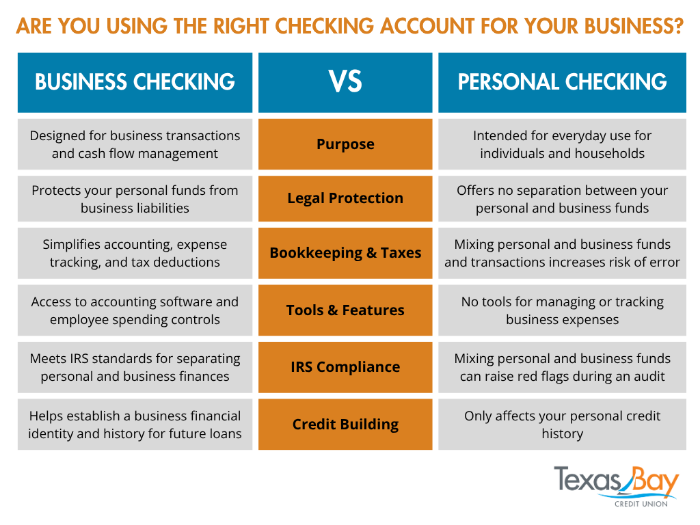
Why Mixing Funds in Your Personal Account Is a Risk
For entrepreneurs, "commingling" personal and business funds comes with big risks:
- Liability Risks: Keeping finances separate preserves the "corporate veil." If your business faces a lawsuit, mixed accounts could allow a court to target your personal home or savings.
- IRS Compliance: The IRS monitors for a "profit motive" to distinguish businesses from hobbies. Clean records ensure you can deduct business expenses, which is not allowed for hobbies under current tax rules.
- Efficiency: Research shows small business owners spend significant time on admin tasks. A dedicated account automates your record-keeping, saving you hours during tax season.
Your Step-By-Step Guide to Switching
Transitioning to a professional setup is a straightforward process:
- Gather Documentation:
-
- Government-issued photo ID (driver's license or passport) for all owners and signers
- Social Security Number (SSN): Required for all owners (typically those with 25% or more equity)
- Employer Identification Number (EIN)
- Formation Documents (varies depending on LLC vs Corp vs partnership)
- Assumed Name Certificate (DBA)
- Operating Agreement/Corporate Bylaws
- Initial Deposit (depends on acct)
- Proof of business address
- Select Your Account: Choose a financial partner and account tier that suits your needs. Pay close attention to their fee structures, monthly transactions, and included tools.
- For example, Simply Business Checking offers 100 free monthly transaction items and digital wallet capabilities.
- Update Revenue: Once you’ve set up your account, link your payment processors directly to the new account.
- Redirect Expenses: Move recurring costs like marketing or rent and utilities for a commercial space to your new business debit card.
- Establish a Pay Cycle: Pay yourself via a set transfer or check labeled as an "Owner's Draw" to keep records pristine.
FAQ: Switching to a Business Checking Account
Do I need a business account for a side-hustle?
Yes. Separation is vital for liability protection and accurate tax filing, regardless of your business size.
What documents are needed to open a business checking account in Houston and surrounding cities?
Typically, you'll need your EIN, personal ID, and an Assumed Name Certificate from your county clerk’s office.
Is it difficult to switch?
No. With a local partner, you can often verify documents and open your account in a single visit.
Choosing a Local Financial Partner
Your business journey is easier with a partner who knows the local market. From Richmond and Cypress to League City and East Houston, Texas Bay empowers entrepreneurs with smarter banking tools and dedicated expert support.
Ready to take your business to the next level? Schedule an appointment with a Texas Bay Business Expert today and let’s power your goals together.